
What GSMs Need to Know About the Automotive Purchase Funnel
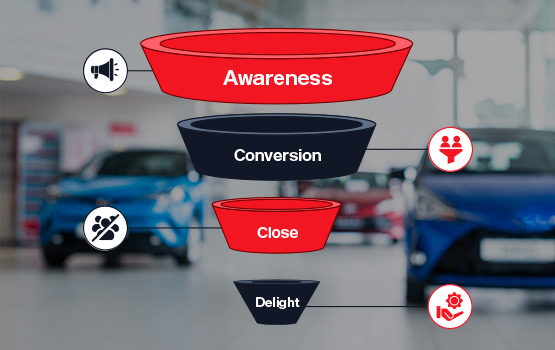
The automotive purchase funnel maps a buyer's path from first awareness of a vehicle to the moment they sign. For a general sales manager (GSM) or Dealer Principal, its value lies in knowing exactly where deals fall apart and margin disappears before you see it coming.
Click volume looks healthy. Leads are coming in. Your team is setting appointments. And yet specific VINs keep sliding past the Day 15 warning window toward Day 60, price drops are eating into per-vehicle retail (PVR), and your CRM and ad platform dashboards say nothing about why those particular units are bleeding out.
Margin disappears in the distance between aggregate metrics and VIN-level reality. Below are two failure points where deals collapse before your team has a chance to save them, along with the demand signals that make each one visible early enough to act on.
Key Takeaways
- Anonymous shopper behavior is the most underused intelligence layer in the automotive purchase funnel, because most in-market buyers who visit a VDP never submit a form.
- When one buyer purchases a vehicle, the CRM can mark every other lead on that unit as lost, even though those shoppers may still be actively evaluating similar units.
- Clicks and form submissions are lagging indicators that miss the two costliest failure points in the automotive purchase funnel, which are anonymous, high-intent shoppers and aging, at-risk VINs.
- Allocating ad spend to easy-to-sell units instead of aging VINs with eroding margins is a structural funnel failure and a media-buying inefficiency.
- Declining VDP activity and search-position shifts on specific units can signal funnel breakdown before Day 15, which gives GSMs a narrower but actionable intervention window.
The Funnel Isn't Broken Everywhere
For a GSM, the funnel breaks down in two places. The first is anonymous high-intent shoppers who evaluate a specific vehicle detail page (VDP) and disappear without entering your CRM. The second is at-risk VINs that age past the margin-positive window because ad spend flowed to easier units instead.
Upper-funnel attrition is significant, yet it sits outside your operational control. YouGov's 2026 U.S. auto rankings data shows Ford with 30.1% consideration among in-market buyers, trailing category leader Toyota at 44.7%. Brand investment and original equipment manufacturer (OEM) media strategy drive that difference, not decisions you make on the lot this week.
Your margin pressure lives further down. A shopper who lands on a specific VDP, returns twice, and never submits a form is invisible to your CRM and your ad platform. A VIN sliding past Day 60 unsupported because your paid media defaulted to the fast movers belongs in the same category. Both sit below the top of the funnel, both are recoverable with the right visibility, and both are where this piece focuses.
For a stage-by-stage breakdown, see how to move customers through the car sales funnel. The diagnostic below starts where margin pressure sits. It covers the high-intent shopper your stack can't see and the VIN your spend isn't protecting.
Failure Point One: Anonymous High-Intent Shoppers
Your highest-intent shoppers are already on a specific vehicle page, comparing trim levels, checking photos, and returning for a second look, and your CRM stays empty. Every workflow in your stack, from business development center (BDC) follow-up to retargeting, waits for a form submission that never comes.
Real purchase intent goes dark in the distance between active shopper behavior and the moment your tools recognize it. The sections below explain why VDP visits disappear, what pre-form behavior looks like, and how to act on it before the shopper moves to a competitor's lot.
Why VDP Visits Disappear Without a Trace
Most in-market buyers who visit a VDP never submit a form, so your CRM and ad platform record nothing while the shopper actively evaluates that unit. The shopper moves through your lot digitally while your team waits for a lead, alert, or follow-up trigger that never fires.
A shopper who views the same VDP twice within three days is telling you something concrete about intent. The shopper came back to look at the same vehicle again. Without identity resolution, that return visit blends into background noise in your GA4 data, and your team cannot act on it.
That delay has a direct cost. Analysis of more than 8 million sales opportunities from the first half of 2025 shows dealership close rates sitting at 12.4% during days one through three, then collapsing to 2.3% during days four through seven. The window to convert a high-intent shopper is closer to 72 hours than a week.
Every anonymous VDP visit that goes unidentified is a buyer you cannot reach before that window closes. That makes it a margin problem. Reaching a shopper on day two instead of day five separates a won deal from a lost one.
What Pre-Form Demand Signals Actually Look Like
Pre-form demand signals are VDP return visits, time-on-page patterns, and repeat views of the same unit across sessions. These are the clearest indicators that a specific shopper is evaluating a specific VIN before any form exists to capture them.
The behavioral sequence looks like this in practice:
- Initial VDP visit: A shopper lands on a unit page, spends meaningful time reviewing photos, pricing, and specs.
- Return session: The same shopper comes back to that exact VIN within days, sometimes hours, without clicking an ad a second time.
- Repeat unit views: They pull up the same vehicle page across multiple sessions, often comparing it against a second or third vehicle on your lot.
That sequence adds up to anonymous intent accumulating at the VIN level, invisible to every workflow your team relies on to prioritize follow-up.
How Identity Resolution Closes the Visibility Gap
Identity resolution converts anonymous VDP traffic into named shopper profiles. That creates a pre-form intelligence layer that form submissions and click reports can't provide. A shopper who views the same F-150 three times across two sessions and never submits a form is invisible in your CRM.
The Lotlinx platform builds this layer by cross-referencing first-party web signals, CRM records, and dealer management system (DMS) data to match anonymous site behavior to real shopper identities. A return VDP visit, a specific trim viewed, and a session length that signals genuine evaluation can all connect to a person your BDC can contact, instead of a session ID that disappears when the browser closes. (Note: All data handling follows Lotlinx’s privacy policy.)
The platform’s current identification benchmark sits at 20 to 30% of website visitors, with a long-term target of 50% or higher. Even at the lower end of that range, you convert a significant portion of your anonymous traffic into workable intelligence before a shopper submits a single form. Your competitors treat that demand as invisible.
Where Margin Drains at the Bottom of the Funnel
Your funnel breaks at the bottom when one vehicle sale causes the CRM to classify every other active lead on that unit as lost, even though those buyers didn't stop shopping.
The cause sits in the CRM's own lead-status logic, which flags active, in-market buyers as done. The two sections below diagnose how that multi-lead scenario plays out and why CRM status is a poor proxy for current shopper intent.
When One Sale Closes Four Active Buyers
When one buyer purchases a VIN, the CRM marks every other lead on that unit lost, even though those four shoppers are still in the market and looking for a comparable vehicle. Closing out the leads is the right move for that VIN, yet those four shoppers keep shopping. They move on to the next similar unit, at your store or somewhere else, and "somewhere else" is the problem.
Research from Urban Science and Harris Poll found that only one in three dealership leads buys from the store they originally contacted, and 20% of CRM leads defect to a competing store. The four buyers your BDC just marked lost are the shoppers that statistic describes.
The operational fix is knowing which of those closed-out leads have resumed browsing your site before they convert somewhere else. That blind spot at the bottom of your funnel is measurable when the right data feeds into your CRM.
Why CRM Status Is Not a Shopper Intent Signal
A "lost" or "unresponsive" status in your CRM records the last action your BDC agent took, rather than what the buyer is doing now. The two measure different things, and conflating them costs you recoverable revenue.
Your BDC marks a lead lost because calls went unanswered and emails bounced. Meanwhile, that same shopper is back on your site, pulling up listings for similar vehicles, comparing trims, and returning for a second session. Your CRM ignores that activity because your team already closed the lead.
Revive exists to catch that blind spot. When a lead that your BDC marked lost resumes active browsing of vehicle pages, Revive detects the renewed behavior through first-party web signals and routes a high-priority alert back into your CRM. Your team sees a live opportunity instead of a cold outreach attempt.
A generic re-marketing blast goes to everyone who ever submitted a form, while Revive flags a specific, named person who already expressed interest in a specific vehicle and is shopping again right now. That is recoverable revenue your team already wrote off, and Revive surfaces it before the shopper walks into a competitor's store.
If your team closes out leads every time a vehicle sells, audit that pool of supposedly dead leads.
Why Clicks and Forms Miss Both Failure Points
Clicks and form submissions are lagging indicators that can't surface anonymous VDP behavior or unit-level aging risk, because both failure points develop before a form ever appears in your CRM. By the time a form lands, the buyer has already worked through most of their evaluation, and a large portion of in-market shoppers never submit one at all.
Your dashboard can show strong click volume on a VIN while that unit continues to age on the lot. Clicks record whether your ad reached someone and got tapped. Which specific buyer is evaluating which specific unit right now, and whether that shopper has already moved on, stays invisible.
The anonymous high-intent visitor and the buyer your team wrote off as "lost" both stay outside what click and form data can surface, and both represent demand your current reporting treats as nonexistent.
For a GSM, both failure points develop before a form ever appears. Acting on them takes visibility into pre-form behavior and real-time vehicle-level demand, rather than a faster response to the leads your current stack already catches.
Get the Metrics That Diagnose Funnel Breakdown
VIN-level metrics diagnose funnel breakdown before Day 15 forces your hand, while total leads and overall VDP sessions, the metrics most GSMs watch, are lot-wide aggregates that can hide a single VIN deteriorating underneath a stable average.
These signals tell you a VIN is in trouble before Day 15 arrives:
- Declining VDP activity on a specific unit while lot-wide traffic holds steady
- Search-position deterioration on that VIN's trim or configuration
- Anonymous return visits with no lead submission
- Rising competitive supply on matching units in your market
- Price-position changes that push you outside the top tier without a corresponding markdown
- Days-on-lot trajectory that's already trending past your store's historical turn rate before the two-week mark
These signals identify anonymous high-intent shoppers and at-risk VINs before the margin is gone. Return visits and demand cues that a form never captures reveal the first group, and VIN-level metrics instead of lot-wide averages reveal the second.
LotGPT reads your live inventory feed, CRM, and GA4 signals to surface these warnings before a VIN crosses Day 15 and your margin options start disappearing.
See which units on your lot are already showing these patterns: Pull up your lot's early-warning signals now.
Frequently asked questions
How is the automotive purchase funnel different today than it was a decade ago?
Today's car buyers complete the vast majority of their evaluation online before contacting a dealership, so the online research phase has become the selling floor. Shoppers arrive at the lot with a vehicle largely chosen, which leaves dealers a narrow window to influence the decision. A dealer who stays invisible and unidentified during those VDP sessions rarely gets a second opportunity at the physical lot.
How quickly does a dealership's window to convert a high-intent shopper actually close?
Dealership close rates fall from 12.4% in the first three days of contact to just 2.3% during days four through seven, based on analysis of more than 8 million sales opportunities in the first half of 2025. That drop-off means your conversion window runs in days, not weeks. Any workflow that waits for a form submission before triggering follow-up is already operating behind that curve.
What percentage of dealership leads actually defect to a competing store?
On average, 20% of CRM leads defect to a competing store, and only one in three leads buys from the dealership they originally contacted, according to a 2026 Urban Science Harris Poll Study of 3,012 U.S. auto buyers. That defection rate means a significant share of your CRM pipeline is actively shopping your competitors right now. Leads that your BDC marks "lost" or "unresponsive" may simply be in a competitor's lot.
Does VIN-level demand matching replace a dealer's existing ad platforms, or does it work alongside them?
VIN-level demand matching works alongside your existing paid media, including Google, Meta, and OEM co-op campaigns, by reallocating how budget flows across those channels based on which specific units are at risk rather than running uniform spend across the lot. The core problem it solves is structural. Most ad platforms optimize for traffic volume instead of directing in-market shoppers to the VINs that need a push before margin erodes. VIN-by-VIN spend allocation uses live demand and aging risk signals, so budget reaches at-risk units instead of only the ones that would have sold anyway.
Can a GSM act on automotive purchase funnel breakdown signals before Day 60 on a VIN?
You can identify at-risk VINs well before Day 60, because declining VDP activity, search-position deterioration, rising competitive supply, and price-position changes begin appearing as early as Day 15 in live inventory and GA4 data. LotGPT reads those signals directly from a dealer's inventory feed, CRM, and GA4 to surface early warnings without requiring the GSM to open multiple dashboards. The intervention window is narrow, but acting at Day 15 on a flagged VIN preserves margin options that are gone by Day 60.
Share this post: